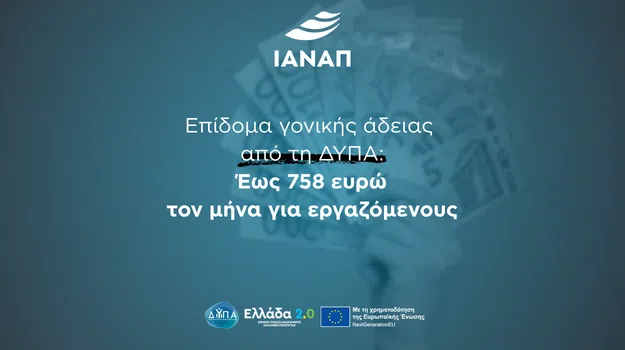
Length of parental leave and period of subsidy
The total length of parental leave can be up to four months for each child. The leave can be taken continuously or in parts, depending on the employee’s needs and agreement with the employer. In some cases, it can also be used in flexible forms, such as reduced daily working hours or taking individual days of leave.
DYPA subsidizes the first two months of leave. If both parents use their right for the same child, the family can receive a subsidy for up to four months in total, that is, two months for each parent. This option provides real support for families who want to share the care of their child.
The allowance is tax-free, protected from seizure and cannot be offset against debts to the state, social security funds or banks. It is also not counted as family income, which may be particularly important for families who receive or are applying for other social benefits.
What you need to apply
Form E.14 for granting parental leave plays a key role in the procedure. This form is submitted by the employer to the ERGANI system and includes information such as the details of the business and the employee, the hiring date, the working hours, the child’s social security number (AMKA), the period of leave and how it will be taken.
Once the form appears in the system, the employee can submit their application digitally through DYPA’s online services. Personal Taxisnet credentials are required to access the platform, and contact details must have been confirmed in the National Communication Register.
Although form E.14 is the main supporting document in the procedure, DYPA reserves the right to request additional information or documents when this is considered necessary to examine an application. For this reason, beneficiaries should carefully check that the details entered by their employer are correct.
Conditions and special cases
As a rule, the employee must have completed one year of work with the same employer, either in continuous employment or through successive fixed-term contracts. However, where there is a more favorable agreement or special provision and the employer grants the leave earlier, the subsidy can also be paid, provided this is shown on form E.14.
Special provision is made for single-parent families. Parents with sole parental responsibility, for example due to the death of the other parent, the removal of parental responsibility or the child not being recognized, can receive double the leave and subsidy period. Likewise, in the case of twins or more children born at once, additional subsidy time is provided.
During the subsidized period, DYPA covers the beneficiary’s social security for main pension, sickness and supplementary insurance. This ensures that taking parental leave does not lead to a loss of insurance rights.
A useful note for employees and employers
Being informed in time and entering the details correctly are decisive steps for completing the procedure smoothly. Employees who want to use the parental leave allowance should contact their employer in good time, confirm that form E.14 has been posted and submit the online application once the relevant entry appears in the system.
Parental leave subsidized by DYPA is a real tool for supporting families and the balance between professional and personal life. Interested people can find detailed information on the official online services of DYPA and gov.gr, which set out the conditions, supporting documents and application steps.