
High-Phenolic Olive Oil Production & Promotion: Modern Practices in the Olive Grove, the Mill and the Market
High-Phenolic Olive Oil Production & Promotion: Modern Practices in the Olive Grove, the Mill and the Market
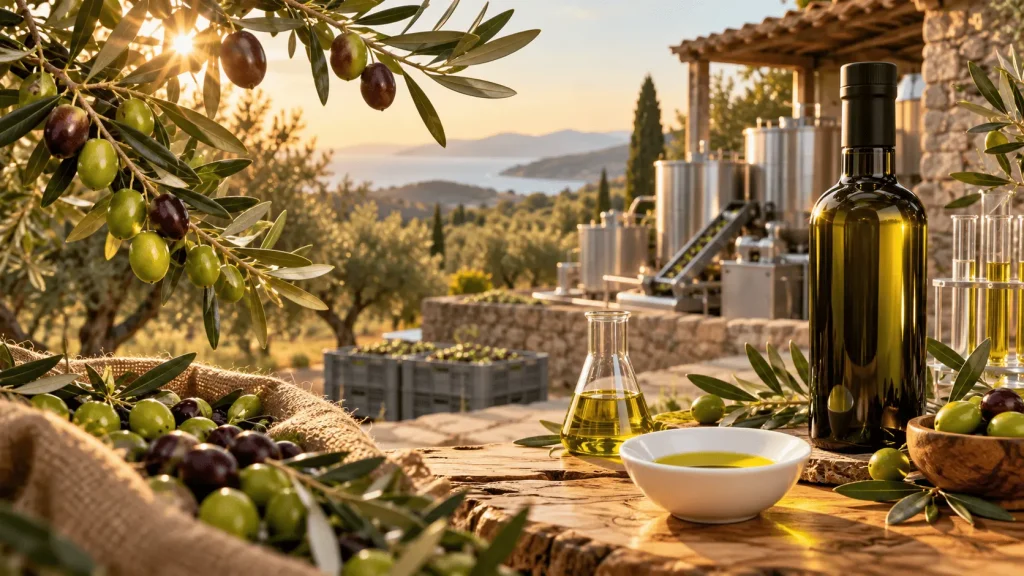
The specialised training programme “High-Phenolic Olive Oil Production & Promotion” offers a comprehensive approach to the entire olive oil value chain, from olive grove management and harvesting to olive oil extraction, laboratory documentation, bottling and strategic promotion on the market.
With a Farm-to-Mill-to-Market philosophy, the programme connects Agronomy, Extraction Technology and Agricultural Economics/Marketing, focusing on managing and preserving the phenolic content at all critical stages of the production process.
Participants learn modern practices in crop management, irrigation, nutrition, crop protection and harvesting, examine the critical parameters of olive oil extraction and storage, and become familiar with the main laboratory methods for determining phenolic compounds and the requirements of the European health claim.
The programme also covers the economic dimension of producing premium olive oil: costing, positioning, branding, packaging, storytelling, digital marketing and the opportunities for developing B2B and export channels.
Also in this category: Intercultural Education: multiculturalism in the Educational System (PAMAK) · Introduction to Geopolitics
Upon completion of the programme, participants are expected to be able to:
- understand the role of polyphenols and the factors that affect their concentration,
- assess the effect of variety, microclimate, irrigation, nutrition and crop protection on phenolic content,
- choose suitable practices for harvesting and transporting the olives,
- recognise the critical parameters of crushing, malaxation, separation, filtration and storage,
- understand the main laboratory methods for determining phenolic compounds,
- interpret the key information in laboratory analysis certificates,
- know the regulatory framework for the European health claim on olive oil polyphenols,
- calculate basic cost and economic viability figures for a premium product,
- develop a clearer USP and positioning,
- develop packaging, branding and storytelling strategies,
- use basic digital marketing and B2B development tools to promote the product.
On completing the programme, trainees gain a complete picture of the journey of a high-phenolic olive oil from the olive grove to the market.
Attending the programme enables participants:
- to understand which factors affect the formation and preservation of polyphenols,
- to recognise the critical points of cultivation, harvesting and olive oil extraction,
- to understand the importance of laboratory documentation,
- to link production quality with economic viability,
- to create a clearer differentiation strategy for a premium olive oil,
- to make use of packaging, branding, storytelling and digital marketing,
- to explore new opportunities for commercial positioning and distribution on the Greek and international markets.
The aim of the programme is to provide comprehensive, applied knowledge of the production, preservation, documentation, differentiation and commercial exploitation of high-phenolic olive oil.
The training approach connects all stages of the value chain – from the olive grove and the mill to laboratory analysis, bottling and the market – so that participants see quality not as an isolated characteristic of the product, but as the result of coordinated decisions throughout the entire production and commercial process.
The programme is designed for:
- Olive growers and farmers who aim to move from selling bulk olive oil to a differentiated, premium, bottled product with higher added value.
- Owners and managers of olive mills who want to upgrade their extraction processes and offer services of higher technological and commercial value.
- Agronomists and agricultural production consultants who wish to acquire specialised know-how in managing phenolic content in the olive grove and during olive oil extraction.
The programme consists of 3 main training modules of 10 hours each.
| Module | Unit | Content | Duration |
|---|---|---|---|
| Module 1: Crop Management & Biosynthesis in the Olive Grove | 1.1 Physiology & Biosynthesis of Secondary Metabolites | The role of polyphenols, their biochemical production pathways, the genetic potential of varieties and the effect of microclimate and altitude on phenolic density. | 2.5 hours |
| 1.2 Controlled Water Stress & Deficit Irrigation (RDI) | Regulated Deficit Irrigation, irrigation timing, water stress management and practices for preserving soil moisture in rain-fed olive groves. | 2.5 hours | |
| 1.3 Nutrition, Fertilisation & Crop Protection | The relationship between nitrogen and polyphenols, the role of key nutrients and the management of pests and diseases that affect the quality of the olive fruit. | 2.5 hours | |
| 1.4 Precision Harvesting & Field Logistics | Ripeness indices, choosing the right harvest time, mechanical harvesting, proper transport of the fruit and managing the time from the tree to the mill. | 2.5 hours | |
| Module 2: Olive Oil Extraction Technology & Laboratory Health Claim | 2.1 Fruit Preparation & Crushing | Leaf removal, washing, choice of crusher, temperature control and enzymatic processes during crushing. | 2.5 hours |
| 2.2 The Science of Malaxation & Separation | Malaxation temperature and time, limiting oxidation, inert atmosphere and a comparison of two-phase and three-phase systems. | 2.5 hours | |
| 2.3 Clarification, Filtration & Storage | Immediate filtration, suitable storage conditions, use of nitrogen in tanks and the evolution of phenolic content during storage. | 2.5 hours | |
| 2.4 Laboratory Detection & Legislation | Basic analysis methods, determination of individual phenolic compounds, reading certificates and an overview of the regulatory framework for the health claim. | 2.5 hours | |
| Module 3: Agricultural Economics, Differentiation (USP) & Strategic Marketing | 3.1 Costing & the Economics of Quality | The economic trade-off of early harvesting, costing per bottle and calculating the break-even point for a premium high-phenolic brand. | 2.5 hours |
| 3.2 Building a Unique Selling Proposition (USP) & Positioning | Differentiation from the conventional product, strategic market positioning and using the organoleptic profile in the commercial narrative. | 2.5 hours | |
| 3.3 Packaging, Branding & Storytelling | Packaging strategy, product protection, corporate identity, storytelling and the basic principles of legal labelling. | 2.5 hours | |
| 3.4 Digital Marketing, Targeted Advertising & Exports | E-shop, Google Search Ads, Meta/Instagram/Facebook Ads and developing B2B channels in Greece and international markets. | 2.5 hours | |
| Total Programme Duration | 30 hours | ||
Certificate of attendance from the Employment Development Institute, a Lifelong Learning Centre certified by EOPPEP & the Ministry of Education.
Methodology
Expression of Interest Form
Completing and sending this form to the Employment Development Institute does not create any obligation or commitment to cooperation.