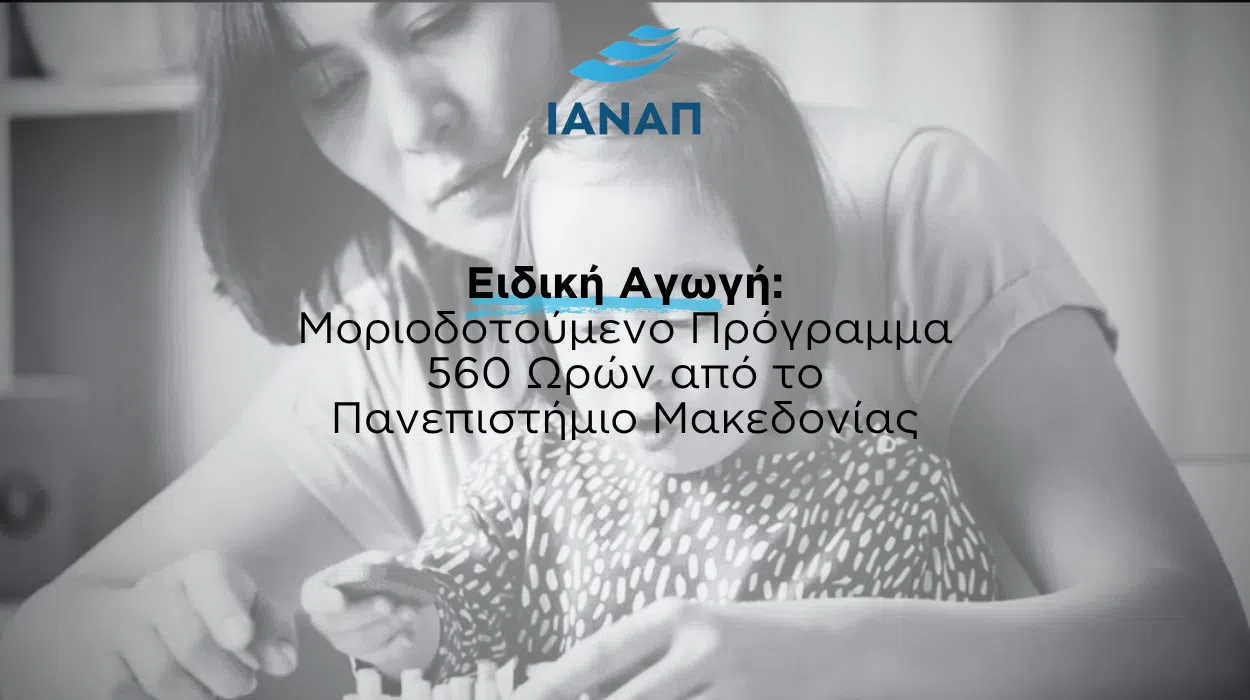
A 560-Hour Program with 20 ECTS
The total duration of the program is 560 hours over 7 months and 5 days, and it corresponds to 20 ECTS credits. It is delivered entirely online, combining synchronous and asynchronous e-learning.
This format is particularly convenient for working teachers and professionals, as it removes geographical barriers and allows them to fit the training into their daily lives with greater flexibility.
On successful completion of the program, a Training Certificate is awarded by KEDIVIM of the University of Macedonia.
The Academic Director of the program is Konstantinos Papadopoulos, Professor at the Department of Educational and Social Policy of the University of Macedonia.
What Is the Aim of the Program?
The main aim of the training is for participants to gain knowledge and skills at both a theoretical and a practical level, so that they can contribute effectively to the education and support of students and adults with special educational needs.
Particular emphasis is placed on accessibility and on the use of assistive technology, which can be an important tool for removing barriers and increasing the participation of people with disabilities in education.
The knowledge gained can be applied in different educational and professional settings: from mainstream schools and Special Education School Units to post-secondary education institutions, care facilities and rehabilitation centers. These skills can also be applied on an individual level to support people with disabilities outside organized educational settings.
Who Is It For?
The program is designed for a wide range of professionals. These include teachers, psychologists, IT specialists, social workers, adult educators, as well as specialists from various scientific fields.
It is aimed both at professionals who already work, and at those who are going to work, in mainstream schools, Special Education School Units in primary, secondary and post-secondary education, and in care facilities and rehabilitation centers for people with special educational needs and disabilities.
It can also be an option for anyone more generally interested in working in the fields of accessibility, education and the rehabilitation of people with disabilities.
Points for Teachers
An important feature of the program is that it earns points, under the relevant legal framework for specialization programs in Special Education.
According to the program details, it provides 2 points in the teacher appointment system through ASEP (Greek Supreme Council for Civil Personnel Selection), as well as 10 points for appointments of TE and DE teachers, while inclusion in the substitute teacher lists is also provided for under the relevant legislation.
The points, combined with specialization in Special Education and accessibility, make this training particularly attractive for teachers who want to strengthen their professional and academic qualifications.
Two Options for the Final Assessment
Flexibility is also offered in the assessment process, as each trainee can choose one of two different methods.
The first option is a written online exam with multiple-choice questions covering the whole syllabus. To pass the exam, at least 50% of the questions must be answered correctly.
Alternatively, the trainee can choose to write a literature review paper on a topic set by the program’s instructors.
This way, each participant can choose the form of assessment that best suits the way they want to complete their training.
Starting September 1, 2026
The program is set to start on September 1, 2026, while August 28 is the registration deadline.
With a duration of 560 hours, 20 ECTS, fully online attendance and a Training Certificate from KEDIVIM of the University of Macedonia, the program “Special Education: Accessibility in Education” combines training in Special Education with the modern dimension of accessibility and assistive technology.
Through the partnership between IANAP and KEDIVIM of the University of Macedonia, those interested can attend a comprehensive program focused on knowledge and skills with direct application in today’s educational environment and in providing meaningful support to people with special educational needs and disabilities.
Vocational training is an important tool for developing new skills and improving employability. Discover all available programs in IANAP’s Programs section.